
Fracture Mechanics Assessment of a Cracked Nozzle in a Pressure Vessel

Problem
In-service equipment can degrade over time due to factors such as local material loss or cracking. Ensuring continued safe operation throughout the equipment’s design life is critical. However, when conducting engineering analyses such as fracture mechanics assessments, multiple uncertainties must be understood before the assessment can be performed.
In this case, a crack-like flaw was identified at the interior weld connecting a nozzle to the domed end of a pressure vessel. The location of the crack does not correspond to any of the standard solutions provided in published codes and standards, which could lead to non-conservative or overly optimistic results if applied directly. In addition, several other uncertainties were present, including fracture toughness, tensile properties, and the actual crack size, to name a few.
To assist the operators in making an informed decision regarding the risk of keeping the equipment in service versus performing a repair followed by local post-weld heat treatment, an assessment of the flaw’s criticality was required. This included the use of statistical distributions to address the identified uncertainties.
Solution
Fitness-For-Service (FFS) codes, such as API 579-1 and BS 7910, provide methods for evaluating the structural integrity and remaining life of in-service equipment. In many cases, applying the standard solution in a Level 2 failure assessment diagram is sufficient for the assessment. In this case, the standard solution was not suitable, and therefore, a cracked mesh was embedded into the component to simulate the location and the size of the detected crack. This provided confidence in the stress intensity factor and the reference stress solutions obtained to be applied in the analysis. To deal with other uncertainty, such as toughness and tensile properties, industry-known statistical distributions for these parameters were applied and utilised in a 10,000 trial Monte Carlo simulation.
Result
To gain confidence in the outcome of the assessment, a Level 3 fracture mechanics assessment was carried out, including a Monte Carlo. This provided the operations with information on the risk associated with operating the equipment, for example in this case, 59 failures in 10,000 trials (0.6%) were deemed unacceptable, and therefore measures were taken to enhance the inspection to give added confidence in the sizing of the crack detected.
Additionally, protection against plastic collapse for the nozzle and domed end was assessed using ASME VIII Part 5 elastic-plastic analysis methods.

Von Mises stress (MPa) – with incorporated crack

Maximum Principal stress (MPa) – with incorporated crack
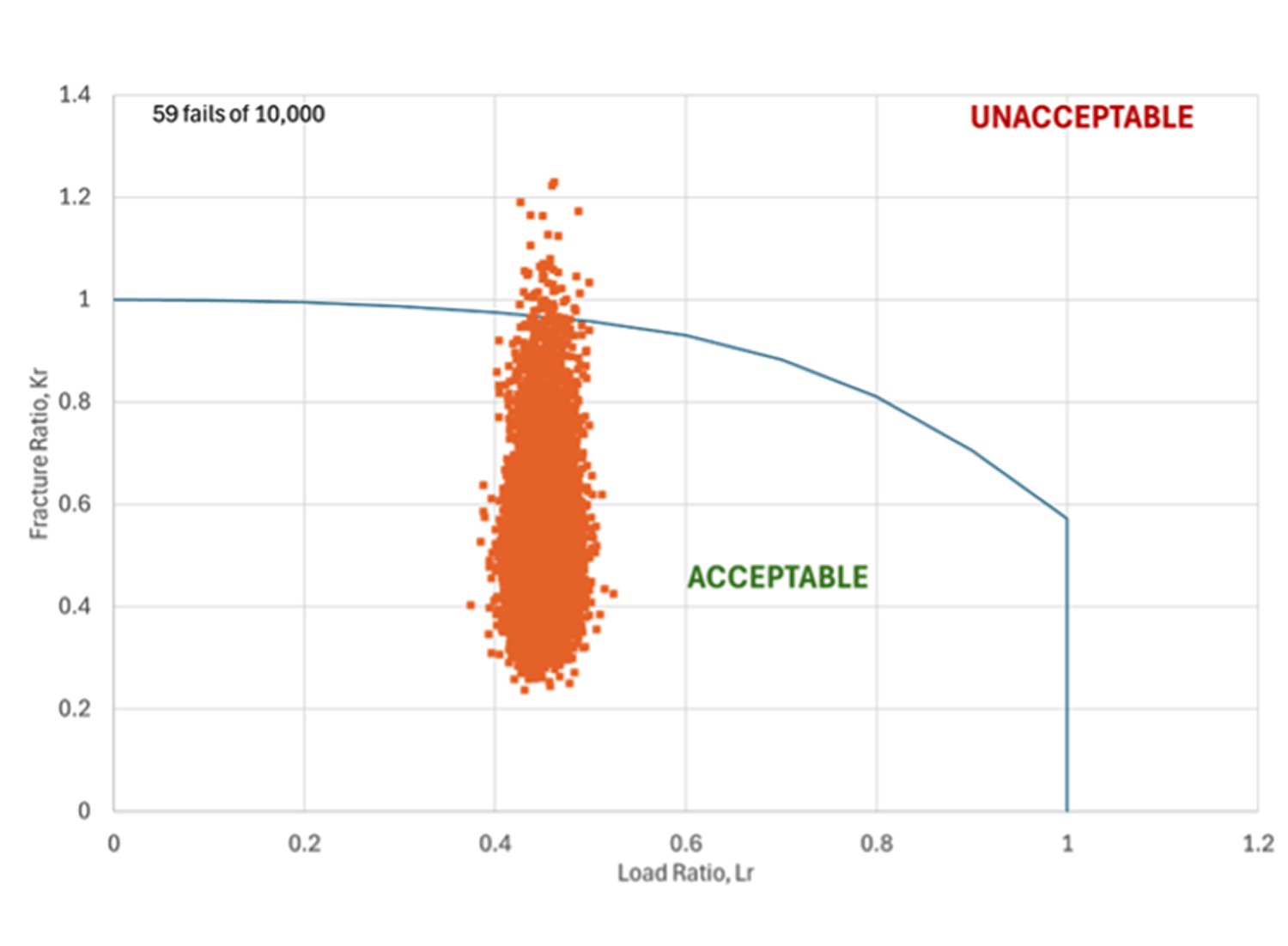
Failure Assessment Diagram showing 10,000 assessment points with 59 being unacceptable (0.6%)