From Instability to Performance: Jet Boat Optimisation Using CFD
High-performance jet boats operate in an exceptionally demanding hydrodynamic environment, where strong coupling exists between the hull, propulsion system, and the surrounding free surface. At high speeds, even small changes in pressure distribution or flow attachment can lead to large changes in trim and handling. Unchecked cavitation, and air ventilation can degrade handling characteristics or, in extreme cases, compromising safety. During on-water testing of a prototype jet boat, severe instability was observed at high speed, resulting in a sudden and unpredictable loss of control. The behaviour was highly transient and only occurred once a critical speed threshold was exceeded, making it difficult to safely reproduce through traditional testing. This case study demonstrates how advanced Computational Fluid Dynamics (CFD) modelling in STAR-CCM+ was used to identify the root cause of the instability and guide a robust design solution (Figure 1).
Simplified single phase CFD modelling proved insufficient for this problem and physical testing was impractical. While these approaches can provide useful performance trends, they offer limited visibility into transient multiphase flow behaviour and cannot reliably capture the interaction between cavitation, free-surface ventilation, and hull dynamics. Scale model testing is incredibly demanding at the high Froud number flows. As a result, the underlying instability mechanism remained poorly understood prior to high-fidelity simulation.
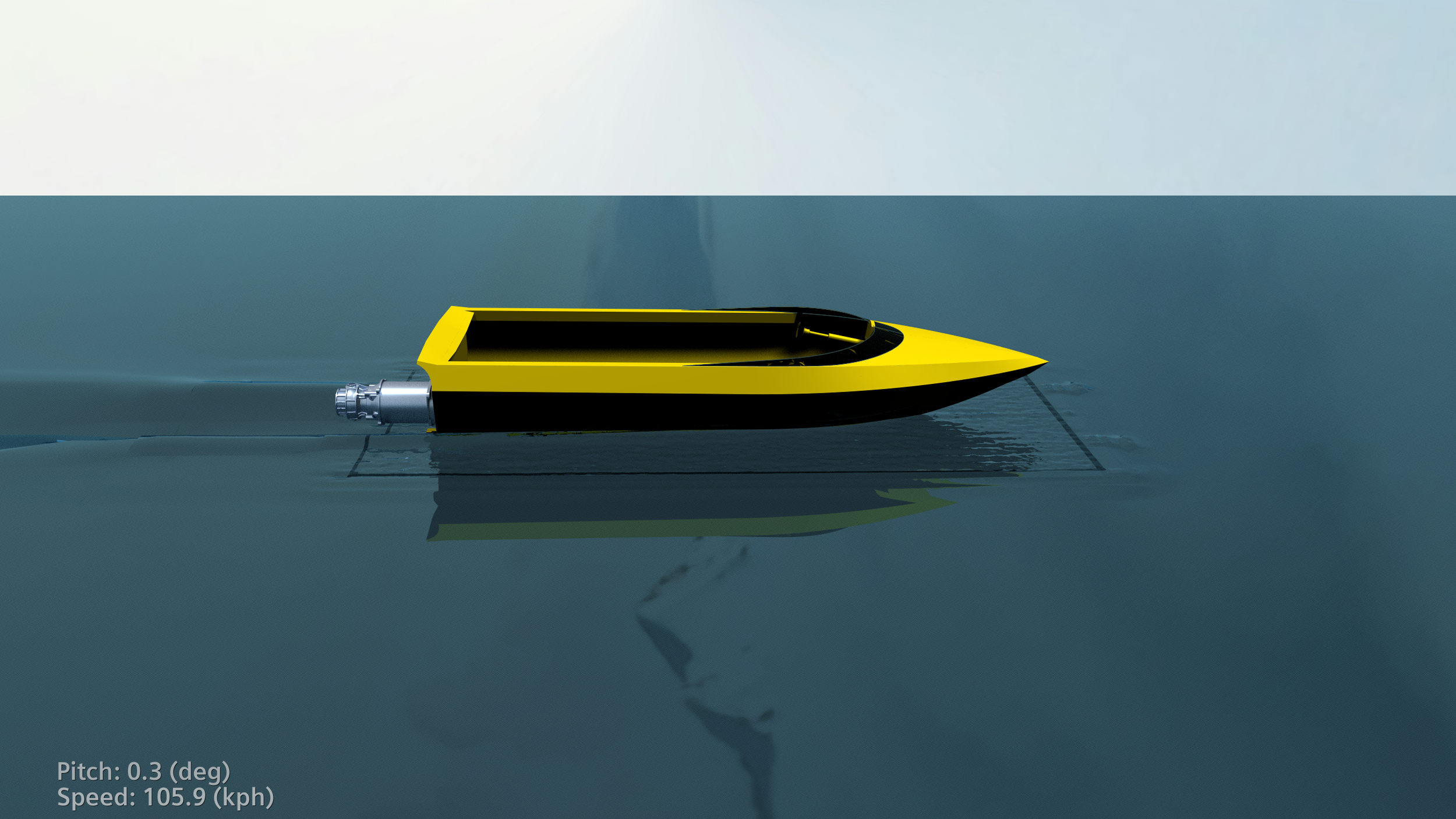
Figure 1.
CFD-predicted free-surface shape at 106 km/h
As vessel speed increases, the mass flow entering the intake rises rapidly. Beyond a certain operating point, the jet pump is no longer able to process all the incoming water. This mismatch leads to a rapid increase in intake pressure, producing an additional vertical force acting on the aft section of the hull. Under stable operating conditions, attached flow beneath the hull and along the cut-water plate plays a critical role in maintaining trim. These flow structures generate stabilising hydrodynamic forces that counteract changes in intake pressure, particularly at higher speeds where pressure levels increase significantly. However, CFD revealed that this balance becomes increasingly delicate as the operating envelope is pushed toward peak performance.
A key outcome of the CFD-based root-cause analysis was the identification of a coupled instability mechanism involving both cavitation and air ventilation. Localised low-pressure regions developed on the hull, promote the onset of cavitation. At the same time, these low-pressure zones draw air from the free surface into the intake. This air ingestion disrupted pressure recovery on intake surfaces, producing unbalanced forces and moments acting on the hull. Once cavitation and air ingress commence, however, elevated intake pressure generates a strong nose-down pitching moment.
To accurately capture these effects, a multiphase Volume-of-Fluid (VOF) modelling approach was employed, coupled with full six-degree-of-freedom (6DOF) vessel motion. This combination allowed STAR-CCM+ to resolve the evolving air–water interface while simultaneously predicting changes in trim, sinkage, and pitch response as the instability developed.
This modelling approach was critical in linking the local flow physics directly to global vessel dynamics. The simulation captured the transient onset of cavitation, the formation and transport of ventilation bubbles, and the resulting redistribution of pressure on the hull and cut-water plate. Without this level of physical fidelity, the instability mechanism would not have been detectable.
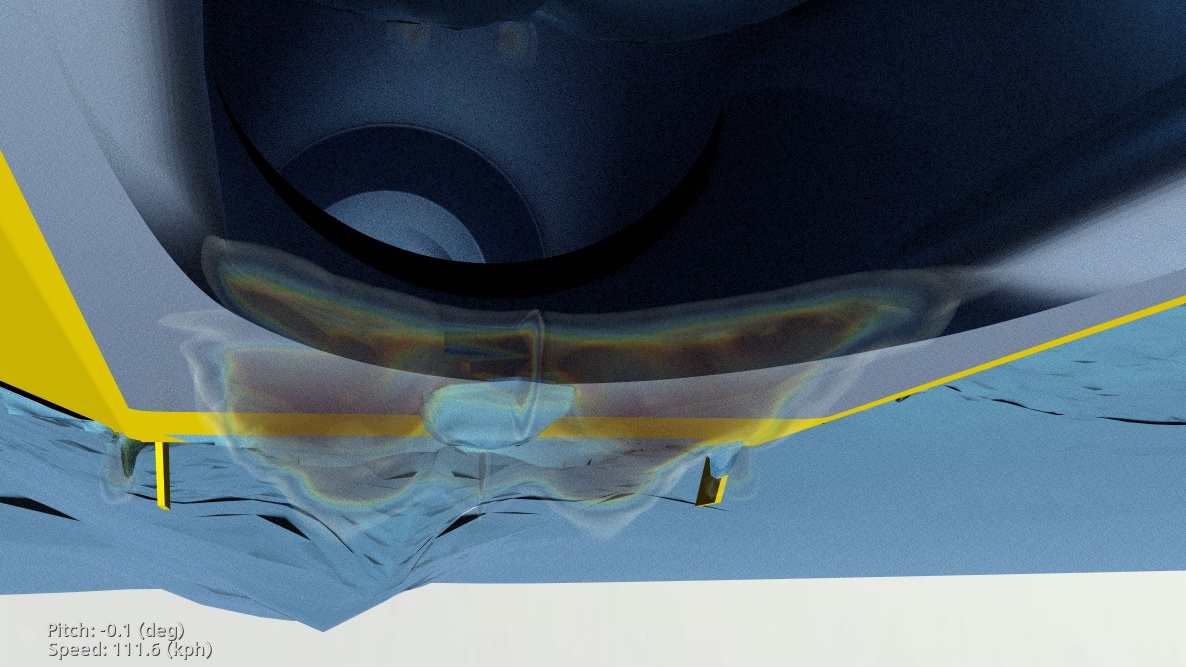
Figure 2. CFD Predicted cavitation and ventilation bubbles
By resolving these tightly coupled multiphase effects, the simulation enabled targeted design modifications aimed at restoring force balance and improving high-speed stability. Geometry refinements to both the cut-water plate and intake were evaluated virtually, allowing Sequence to assess how each change influenced cavitation risk, air ingestion, and dynamic behaviour across the full operating envelope. The CFD results provided clear visualisation and quantitative evidence of performance improvements, enabling confident decision-making early in the redesign process. This significantly reduced reliance on costly iterative prototyping and de-risked subsequent physical testing. Ultimately, the project demonstrated how high-fidelity CFD can transform complex, unstable marine systems into robust high-performance designs—turning instability into a competitive advantage through informed engineering.