
Stress Relaxation Cracking: The Silent Threat in High-Temperature Stainless Steel Systems
Stress Relaxation Cracking (SRC) remains one of the least understood yet most costly damage mechanisms in high-temperature process industries. It is often misdiagnosed, overlooked during inspection, or confused with other forms of intergranular cracking. Recent work by Sequence Computational Engineering sheds light on the mechanisms driving SRC in austenitic stainless steels and how material behaviour under stress and temperature leads to long-term failure.
Understanding the Mechanism
SRC often develops in components and piping systems that operate for long periods within a critical temperature window—typically 500–700°C for austenitic stainless steels. Austenitic are typically not subjected to post-weld heat treatment because the heating can harm the corrosion resistance through chromium depletion. When a weld cools after fabrication, it retains high residual tensile stresses, which we often assume for the purposes of stress analysis to be equal to the material’s yield strength at temperature. In service, these residual stresses relax through localised creep deformation. However, if the metal has undergone sensitisation or age hardening, its grain boundaries can become weaker than the grain interiors. This imbalance localises strain along the boundaries, initiating intergranular cracks. An example is shown in Figure 1.
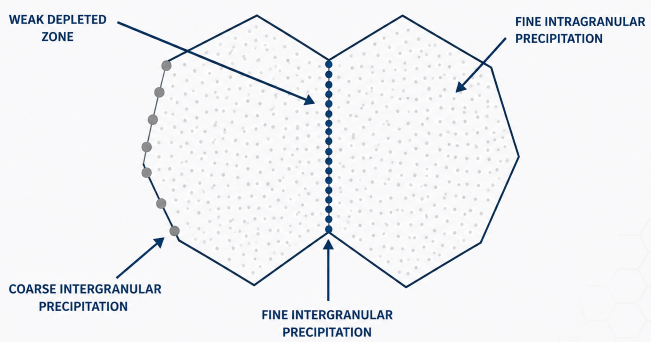
Figure 1.
Theoretical grain structure in which strain is likely to be accommodated by cracking at the grain boundary.
In essence, SRC is a competition between stress relaxation and metallurgical embrittlement. If the stresses are allowed to relax in creep-ductile material, the strain is safely accommodated, and the driving force for cracking disappears. However, when the material hardens faster than it can relax, cracks form.
Why Austenitic Stainless Steels Are Vulnerable
Grades such as 304H, 321H, and 347H are widely used in reactors, heaters, and high-temperature piping because of their corrosion resistance and strength. Yet these same alloys are susceptible to precipitation phenomena—such as carbide or sigma phase formation—that reduce grain boundary ductility over time.
Stabilised grades like 347H or 321H, which contain niobium or titanium to control chromium carbide precipitation, can ironically become more prone to SRC. Their fine precipitates strengthen the grain interiors, leaving grain boundaries comparatively weaker, encouraging grain boundary sliding under stress.
Non-stabilised alloys (e.g., 304H) may also experience SRC, but typically only after long-term exposure and sensitisation/precipitation. In both cases, the common denominator is a loss of creep ductility in the boundary regions combined with residual tensile stresses.
The Role of Residual Stress and Geometry
Residual stresses are highest where geometry constrains movement—such as o-lets, flanges, elbows, or nozzle junctions. These locations prevent uniform expansion and contraction during start-up or shutdown cycles, concentrating stress in narrow zones around the weld toe.
Even without external loading, SRC can develop purely from the locked-in weld stress field. Repaired welds, which undergo additional thermal cycles and strain hardening, are particularly prone to faster re-cracking if not properly stress-relieved.
Detecting and Preventing SRC
SRC often manifests as tight, intergranular cracks just outside the heat-affected zone (HAZ), sometimes several millimetres from the weld fusion line. It can remain invisible to surface inspection until it breaches through-wall thickness.
Key preventative strategies include:
Minimising residual stress through controlled heat input and geometry design
Maintaining microstructural stability by selecting weld consumables with low ferrite and balanced alloy content (e.g., 16.8.2 over 347H)
Post-weld heat treatment (PWHT) to relieve residual stresses and stabilise the microstructure
Even modest reductions in residual stress can extend service life dramatically—since SRC initiation depends exponentially on both stress magnitude and boundary ductility.
A Subtle Form of Creep Damage
Unlike classic high-temperature creep, SRC is highly localised and often delayed—in some cases taking years or even decades to manifest. Its slow, silent progression makes it a time bomb within aging plants. Understanding SRC as a creep-driven relaxation failure rather than a simple metallurgical defect reframes how engineers approach inspection, repair, and materials selection.
“The primary cause of SRC is creep damage that arises during the relaxation of highly triaxial welding residual stresses—geometry and material condition merely determine where it starts.”
In short: SRC is not inevitable—it is manageable. Through smarter material selection, better control of welding stresses, and attention to microstructural evolution, the industry can design out one of the most insidious failure mechanisms in high-temperature stainless steel systems.